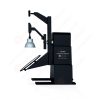
LM-79 Máy đo Goniophotometer phát hiện chuyển động (Loại gương C)
LSG-6000
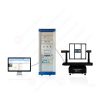
Máy đo độ sáng xoay chính xác cao
LSG-1890B
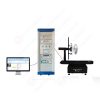
Đèn chiếu sáng xoay chính xác cao Goniospectroradiometer
LSG-1890BCCD

Goniophotometer cho ô tô và đèn tín hiệu
LSG-1950
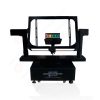
Máy đo quang kế góc cho đèn tín hiệu giao thông (Mẫu tiết kiệm)
LSG-1950S
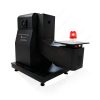
Thiết bị cảnh báo trực quan báo cháy VAD (Visual Alarm Visual Alert Device) - Máy đo quang kế góc
LSG-1930
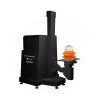
Máy đo quang kế góc cho hệ thống chiếu sáng sân bay
LSG-1940
Máy đo huyết áp nhỏ gọn
LSG-1200A
Máy đo quang kế LED
LSG-1100
Máy dò chuyển động gần trường
LSG-1900B
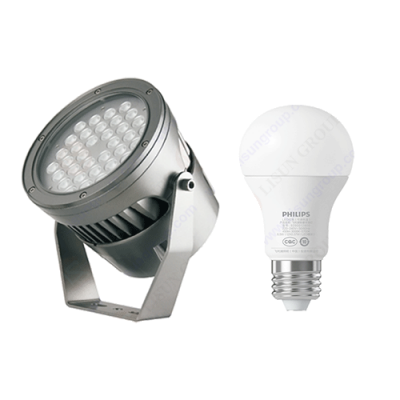 Giải pháp kiểm tra đèn LED và đèn led
 LM-79 và LM-80 Giải pháp thử nghiệm
 Giải pháp kiểm tra trình điều khiển LED
 Giải pháp kiểm tra thiết bị gia dụng
 Giải pháp kiểm tra mạng di động và mạng
 Giải pháp kiểm tra điện tử ô tô
 Giải pháp kiểm tra âm thanh-hình ảnh và CNTT
 Giải pháp kiểm tra dây và cáp
 Giải pháp kiểm tra phích cắm và ổ cắm
 Giải pháp kiểm tra công tắc nguồn
 Giải pháp kiểm tra máy biến áp
 Giải pháp kiểm tra đồ chơi điện tử
 Giải pháp kiểm tra đồng hồ đo năng lượng
 Giải pháp kiểm tra dụng cụ vận hành bằng động cơ
Chọn một tổ chức
để duyệt các tiêu chuẩn
Tóm tắt:
LED light sources show obvious directional selectivity in spatial luminous intensity distribution. Single-point illuminance measurement or central luminous intensity reading cannot support photometric design and compliance judgment. Starting from the engineering implementation of LED light intensity measurement, this paper analyzes the measurement principle, major error sources and data processing workflow of the full-space goniophotometer. Taking LISUN LSG-6000 (LM-79 Moving Detector Goniophotometer, Mirror Type C) as the research object, this paper presents the measured data structure under the C-γ coordinate system, key specifications and selection criteria, providing references for photometric verification and certification testing of luminaire manufacturers.
1 Giới thiệu
The fundamental difference between LEDs and traditional gas discharge lamps lies not only in higher efficiency, but also in small luminous area, strong directivity and remarkable near-field effect. For a 60 W LED street light, its maximum luminous intensity may appear at γ=60°, rather than directly below the luminaire. For the same batch of luminaires, a peak angle offset of 3°~5° caused by mould deviation of secondary optical lenses will lead to obvious deterioration of road surface illuminance uniformity. Therefore, LED light intensity measurement cannot be limited to single-point illuminance reading. It needs to answer three core questions: how the luminous intensity distributes in the 4π space, what the total luminous flux is, and whether the distribution meets the judgment range of target standards. The full-space goniophotometer is the core instrument to solve these problems.
Current standards including IES LM-79-24, CIE S025 and GB/T 22907-2022 require the acquisition of total luminous flux and 3D luminous intensity distribution via goniophotometry, with output in IES/LDT format for verification by DIALux and other lighting simulation software. The angular resolution, detector linearity and stray light level of the measurement system directly determine whether the test report can be accepted by third-party laboratories and certification bodies.
2 Difficulties of LED Light Intensity Measurement and Principle of Full-Space Goniophotometer
Errors in LED light intensity measurement mainly come from three aspects: cosine correction and spectral mismatch (f1′) of the detector; geometric deviation caused by misalignment between the luminous center of the LED luminaire and the rotation axis; superposition of stray light and reflected light inside the darkroom. The first factor affects the absolute magnitude of photometric values, while the latter two affect angular attribution. Once the angular attribution is incorrect, the shape of the light distribution curve will be distorted as a whole.
Goniophotometers are classified into luminaire rotating type (Type A/B) and mirror rotating type (Type C) according to mechanical structure. The core concept of mirror rotating type is that the DUT (device under test) remains stationary, while the detector and reflector move synchronously around the luminaire. The mirror reflects light beams from all directions into the fixed optical path of the detector. The advantage of stationary luminaire is that the heat dissipation condition and burning posture of the LED luminaire are consistent with the actual installation state. It avoids junction temperature drift caused by airflow disturbance during rotation, which is critical for LM-79 testing with only ±0.5% tolerance for luminous intensity stability judgment.
LISUN LSG-6000 adopts this structure: three-axis mechanical drive, γ-axis 0~360°, C-axis 0~360°, mirror synchronous axis 0~360°. It is equipped with a laser alignment system to align the luminous center of the luminaire with the rotation axis. The angular measurement accuracy reaches 0.05°, the illuminance measurement range is 0.0001 lx ~ 200 klx, the system stray light is lower than 0.1%, and the detector is a CIE Class L thermostatic photometric probe with f1′<1.5%. This structure is designed strictly in accordance with IES LM-79-24 and EN 13032-1:2019 (Type 4). It can be upgraded to LSG-6000CCD with a CCD spectroradiometer to realize spatial correlated color temperature, color rendering index and PAR/PPF/PPFD measurement.
Table 1 Main Technical Specifications of LSG-6000 Loạt Sách
| Mục | Đặc điểm kỹ thuật |
| Hệ tọa độ đo lường | Hệ tọa độ cầu C-γ |
| Angular Test Accuracy | 0.05 ° |
| Phạm vi quay | γ-axis 0~360°; C-axis 0~360°; mirror synchronous axis 0~360° |
| Phạm vi đo độ chiếu sáng | 0.0001 lx ~ 200 klx |
| Đầu dò quang trắc cấp độ | CIE Class L thermostatic probe, f1′<1.5% |
| Ánh sáng lạc hệ thống | <0.1% |
| Wavelength Range (CCD Version) | 350~800 nm |
| Color Coordinate Accuracy (CCD Version) | ±0.0015 under standard light source condition |
| Định dạng đầu ra dữ liệu | IES, LDT, CIE, TM4, CEN, Excel |
| Môi trường phần mềm | Chinese & English interface, compatible with Win7 ~ Win11, supports DIALux |
3 Implementation Process and Data of LED Light Intensity Measurement
A complete LED light intensity measurement consists of four steps: darkroom preparation and geometric alignment, burning stabilization, point-by-point scanning and data reduction.
The minimum darkroom height requirement varies by model: the standard LSG-6000 requires 4.1 m, compact LSG-6000S requires only 3.0 m, large version 4.7 m and extra-large version 5.2 m. The corresponding maximum DUT dimensions and weight are Φ1600×600 mm / 50 kg, Φ1200×500 mm / 40 kg, Φ1800×800 mm / 60 kg and Φ2000×900 mm / 80 kg respectively. Darkroom dimension should be confirmed before model selection.
The burning stabilization procedure follows LM-79 requirements: ambient temperature 25±1℃ with controlled airflow disturbance. Three readings are taken at intervals of no less than 30 minutes. Scanning can only start when the variation of luminous flux and electrical parameters is within 0.5%. This step is often simplified in practice, yet it is the main source of systematic deviation in LED light intensity measurement. Luminous efficacy decreases by approximately 0.5%~1% for every 1℃ rise of junction temperature. If scanning starts before thermal stabilization, thermal drift will be embedded into the light distribution curve.
After scanning, the software samples data at equal angular intervals on the C-γ coordinate, outputs luminous intensity values of all directions, and calculates zonal luminous flux and total luminous flux via spherical solid angle integration. Table 2 shows sample data on the C0-C180 plane of a 60 W, 4000 K LED street light (for illustration of data structure and judgment logic).
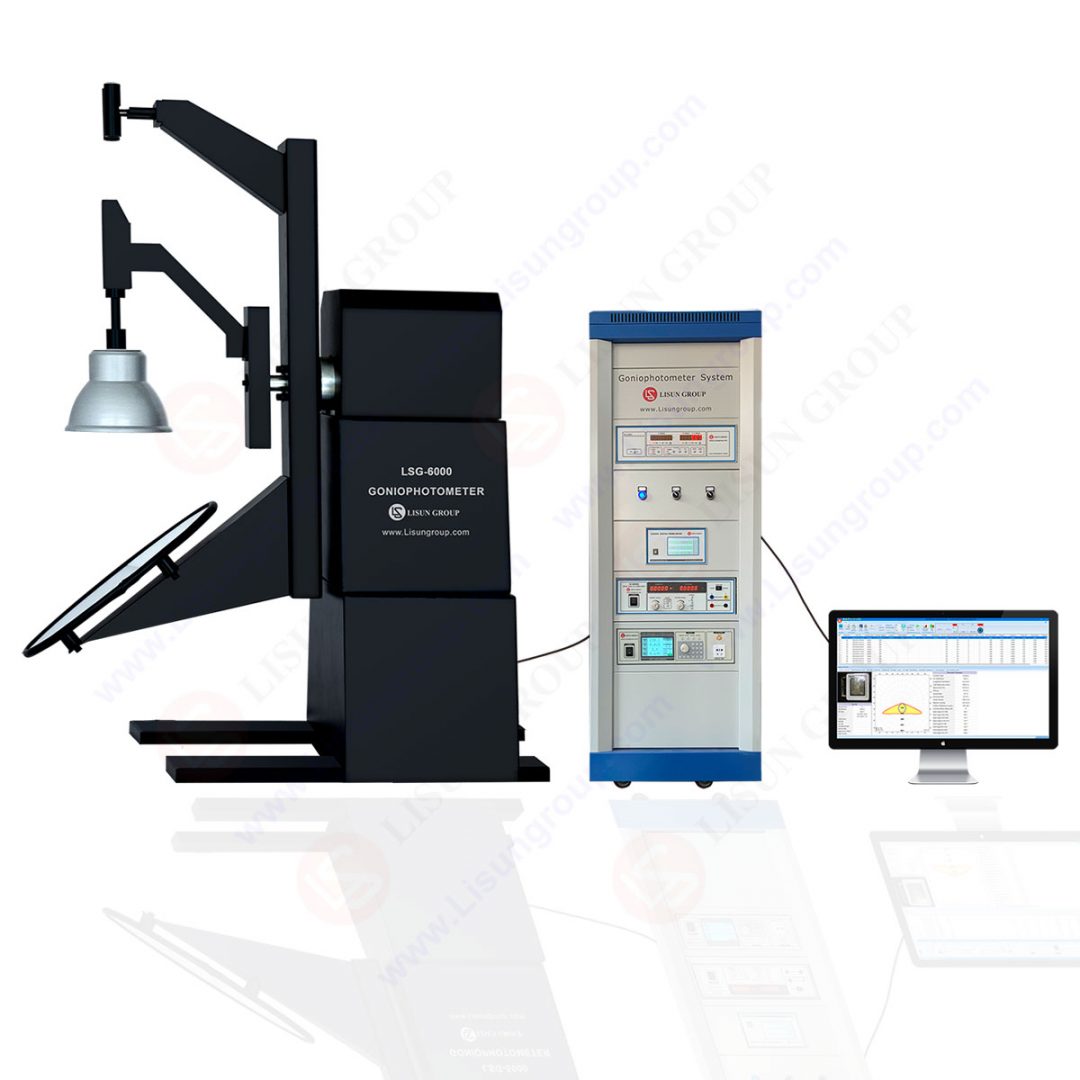
LM-79 Máy dò chuyển động Goniophotometer (Gương loại C) AL
Table 2 Luminous Intensity Distribution on C0-C180 Plane of a 60 W LED Street Light (Sample Data)
| γ angle | 0 ° | 10 ° | 20 ° | 30 ° | 40 ° | 50 ° | 60 ° | 70 ° | 80 ° | 90 ° |
| Cường độ sáng I (cd) | 210 | 245 | 295 | 385 | 620 | 975 | 1180 | 860 | 320 | 35 |
The data shows that the peak luminous intensity of 1180 cd appears at γ=60°, while the intensity directly below is only 210 cd, which is a typical batwing distribution. If the same luminaire is tested by a luminaire rotating goniophotometer, the heat dissipation boundary changes with fixture rotation. The peak angle often shifts by 1°~2°, and the deviation of total luminous flux can exceed 2%. This reflects the practical advantage of mirror rotating structure for LED light intensity measurement.
Table 3 Zonal Luminous Flux Reduction Results (Sample, Total Luminous Flux 7800 lm, Luminous Efficacy 130 lm/W)
| Phạm vi góc | 0 ° ~ 30 ° | 30 ° ~ 60 ° | 60 ° ~ 90 ° | 90 ° ~ 180 ° | Tổng cộng |
| Quang thông (lm) | 1092 | 3120 | 3432 | 156 | 7800 |
| Tỷ lệ phần trăm | 0.14 | 0.4 | 0.44 | 0.02 | 1 |
It can be seen from Table 3 that 86% of luminous flux falls in the downward zone of 0°~90°, and the upward luminous flux accounts for 2.0%, which meets the upward light restriction requirements of conventional road lighting. For BUG rating or LCS classification, statistical grouping shall be redefined according to CIE 121 and IES TM-15 angular partitions.
4 Full-Parameter Output and Instrument Selection Based on Luminous Intensity Data
The deliverables of LED light intensity measurement are more than a single distribution curve. The same dataset can be used to derive beam angle, iso-illuminance / iso-intensity curve, utilization factor, upward/downward flux ratio, UGR, EEI and other indicators. When upgraded to CCD version, it can further obtain spectral power distribution, correlated color temperature, Duv, Ra/R1~R15, CQS, Rf/Rg of TM-30-24, color spatial non-uniformity Δu′v′, as well as PPF and PPFD for horticultural lighting. Electrical parameters (voltage, current, power, power factor, harmonic) are collected synchronously with photometric parameters, which serves as cross-verification to judge the credibility of luminous efficacy data.
Optional accessories also extend the measurement scope: PHOTO-UVA/UVB/UVC probes can cover ultraviolet band of 200~400 nm; LSRF-3 system and CLAMP-LSRF fixture support start-up time, rise time and flicker test, complying with ENERGY STAR V2.1, IEC TR 61547-1:2020, IEEE Std 1789 and other standards.
Table 4 Model Selection Comparison of Four Versions
| Mẫu | Kiểu | Chiều cao phòng tối tối thiểu | Maximum DUT | Kịch bản ứng dụng |
| LSG-6000 | Tiêu chuẩn | 4.1 m | Φ1600×600 mm, 50 kg | General LED luminaires, street lights, panel lights |
| LSG-6000S | gọn nhẹ | 3.0 m | Φ1200×500 mm, 40 kg | Downlights, spotlights, laboratories with limited space |
| LSG-6000B | Chó cái | 4.7 m | Φ1800×800 mm, 60 kg | High-power high-bay lights, floodlights |
| LSG-6000L | Cực lớn | 5.2 m | Φ2000×900 mm, 80 kg | Oversized luminaires, horticultural lighting fixtures |
Kết luận 5
Độ tin cậy của LED light intensity measurement relies on three prerequisites: accurate geometric alignment, stable burning condition and standardized angular & photometric reduction. The mirror rotating full-space goniophotometer fixes the luminaire and makes the detector and mirror travel around it. This structure eliminates the disturbance of fixture posture on LED heat dissipation and light distribution. With 0.05° angular accuracy, CIE Class L probe with f1′<1.5% and system stray light below 0.1%, LSG-6000 realizes repeatable photometric measurement and supports IES and LDT export for lighting simulation. For luminaire manufacturers, it acts as a tool for light distribution tuning in R&D and a measurement platform for LM-79, EN 13032-1 and GB/T 22907 certification. For third-party laboratories, its core value lies in consistent light distribution curves of the same sample across different test dates and operators.
Tags:LSG-6000Địa chỉ email của bạn sẽ không được công bố. Các trường bắt buộc được đánh dấu *

 Tiếng Anh
 中文简体
 Русский
 Español
 Português
 Türkçe
 العربية
 Deutsch
 Polski
 Italiano
 Français
 한국어
 ไทย
 Tiếng Việt
 日本語